DLI Maps for the United States. These are a great way to learn what the DLI is where you live at any time of year - good talking point and poster to print out for a classroom to discuss light as an environmental variable.
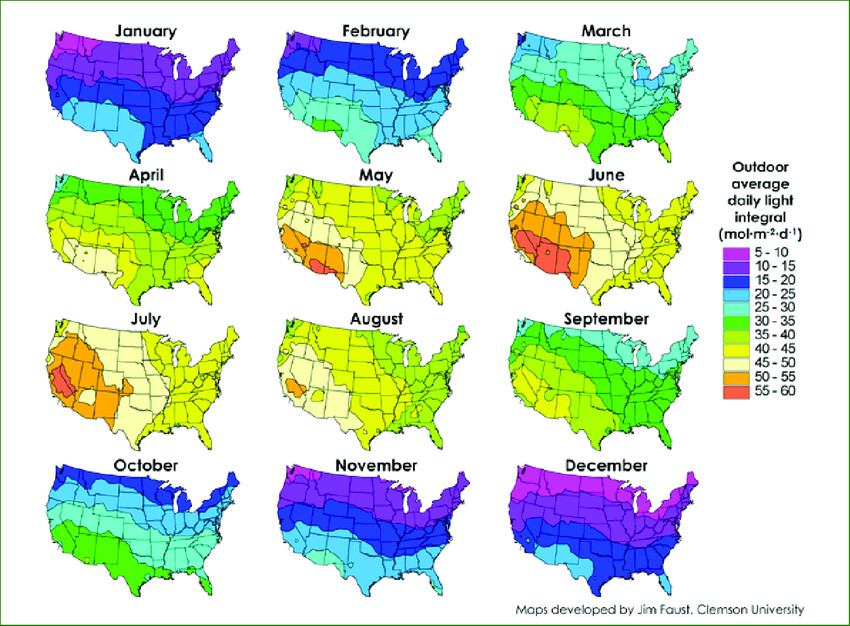
How this map can be used to help students create their own custom recipes for the MV1:
- Start by deciding what you want to grow.
- Then try to determine where that plant is normally grown and at what time of year (Google it or check out Plants Well-suited for Controlled Environment Agriculture - #4 by Peter)
- Other posts in that thread explain how to choose plants that grow quickly.
- Then try to determine where that plant is normally grown and at what time of year (Google it or check out Plants Well-suited for Controlled Environment Agriculture - #4 by Peter)
- Using the known growing seasons, calculate the ‘average’ DLI that the plant would receive during its phases of growth.
- Use the map in the first link to calculate the DLI for that location and time.
- For shorter duration plants (leafy greens) this is shorter - 2-3 months. If it’s longer, worry more about the period when the fruit would be ripening - whenever it gets the most light.
- Convert that DLI into a ‘recipe’ which can be run on the MV1.
- This table shows the settings for the three pre-made DLI ‘recipes’ (DLI: 30, DLI: 21, DLI: 17) that you can pick from to run in your MV1: What does a MARSfarm recipe do? What is JSON? (ChatGPT-4 Response) - #4 by Peter
- Honestly, those three are great place to start for growing any type of leafy green.
- DLI 30 = too much light for most leafy greens.
- Keep in mind, the conversion we make assumes plants that are ~6" tall.
- If you’re growing a tomato or pepper - the DLI will be even higher closer to the lights.
- Other posts earlier in this thread show what a PAR meter is and how we use it to calculate DLI settings for each recipe.
- This table shows the settings for the three pre-made DLI ‘recipes’ (DLI: 30, DLI: 21, DLI: 17) that you can pick from to run in your MV1: What does a MARSfarm recipe do? What is JSON? (ChatGPT-4 Response) - #4 by Peter